San Bernardino public records refer to official documents created or held by county and local government offices. These records show how public agencies operate and document actions tied to courts, property, law enforcement, and vital events. Residents, researchers, and professionals rely on them for verified facts. They support open government and public trust across the county.
San Bernardino public records cover civil and criminal court files, land records, permits, and vital certificates. Each record reflects real activity handled by an authorized public office. Many records appear in digital form through county systems or public databases. This structure allows clear visibility into public matters without confusion.
How to Search Public Records on the San Bernardino County
This county public records search is completed through the San Bernardino County Recorder-Clerk Public Access System, which is the official record search portal for recorded documents.
Official Website
San Bernardino County Recorder-Clerk Public Access System
https://arcselfservice.sbcounty.gov/
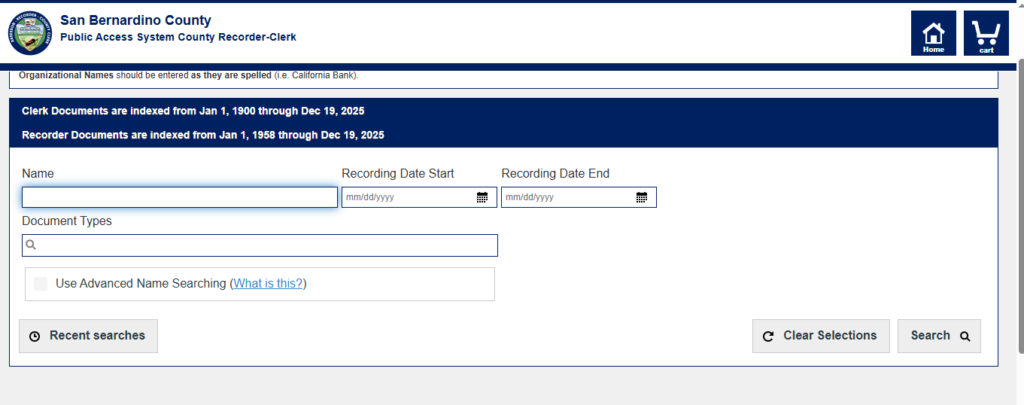
This is the same portal shown in your screenshots.
Open the Official Search Page
- Open a web browser.
- Go to: https://arcselfservice.sbcounty.gov/
- The page title will show “San Bernardino County – Public Access System County Recorder-Clerk.”
This confirms the user is on the correct official website.
Choose a Search Type
On the second screen, users will see multiple search options:
- Name Search
- Document Number Search
- Document Type Search
- Map Book/Page Search
- Advanced Search
Most users should start with Name Search – Web.
Click on the preferred search option to continue.
Use the Name Search
After selecting Name Search – Web, the user will see fields like:
- Name
- Recording Date Start
- Recording Date End
- Document Types
- Option for Advanced Name Searching
How to fill the fields correctly:
- Name field
Enter the full name or partial name.
Example:Smith JohnorSmith - Recording Date Start / End
Use the calendar icon or type the date inmm/dd/yyyyformat.
Short date ranges give better results. - Document Types (optional)
Leave blank for broader results, or select a specific document type if known.
When finished, click Search (bottom right).
Review the Search Results
The results page will display indexed records with details such as:
- Document title or type
- Recording date
- Names listed on the document
- Document or instrument number
These results are part of the county public records index.
Some records may show a view or copy option, while others show index data only.
Document Number Search (Fastest If Known)
If the user already has a document number:
- Select Document Number Search – Web
- Enter the exact document or instrument number.
- Click Search
This method returns the most direct result.
Understanding Index vs Document Images
- Index records show summary details only.
- Document images appear when scanned copies are available.
If a full document image is not visible:
- The user may order copies through the cart option.
- Certified copies may require a fee and county processing.
The site clearly explains copy fees on the left panel of the screen.
Types of Public Records Available
San Bernardino County maintains many categories of public records that document government activity and daily life events. These official records appear across county departments and form a structured county public records search system for residents and professionals.
Each record type serves a different purpose. Some confirm identity or property rights, and others track how local agencies conduct public business.
Vital Records in San Bernardino County
Vital records document major life events and remain among the most requested county public records. County and state offices create and preserve these files under strict legal standards. They help confirm personal status for legal, financial, or family-related needs.
Common vital records include:
- Birth certificates
- Death certificates
- Marriage certificates
These records originate from authorized government offices, not private platforms. They follow set filing rules and retention schedules. As a result, they remain a reliable source for identity verification and historical research.
Property Records and Assessor Data
Property-related official records play a major role in San Bernardino County. The San Bernardino County Assessor tracks ownership, parcel boundaries, and assessed values for tax purposes. These records support real estate transactions, estate planning, and local tax reviews.
Property records often include:
- Deeds and title transfers
- Parcel maps and lot descriptions
- Assessed property values
- Ownership history
Many property files appear through a county public records search system tied to assessor and recorder offices. These records reflect filings submitted by owners, lenders, and legal representatives.
Legal and Recorded Documents in County Databases
San Bernardino County indexes many legal documents that are separate from court case records. These filings involve agreements, notices, and rights tied to property or business matters. County databases store them for public reference.
Examples include:
- Liens and releases
- Trust deeds
- Powers of attorney
- Business filings and fictitious name statements
These official records help confirm legal relationships without involving active court proceedings. They remain distinct from judicial case files.
Administrative and Government Agency Records
Administrative records show how local government offices operate. County boards, commissions, and departments create these documents during meetings and daily work. They provide insight into policy decisions and public spending.
Typical administrative records include:
- Meeting agendas
- Approved minutes
- Policy resolutions
- Budget summaries
- Department reports
These materials help residents follow public decision-making and monitor agency actions. Many appear in digital formats through county-managed systems.
Clear Separation From Court Case Records
Public records and court case records serve different roles. Court case records focus on judicial proceedings, filings, and rulings. Public records cover broader government activity outside the courtroom.
How to Request Copies of Public Records
San Bernardino County allows record requests through official county systems for anyone who needs copies of public records. These requests help users obtain paper or digital copies for legal, business, or personal use.
Public record copies come from county offices that created or maintain the files. The process varies by record type, copy format, and delivery method.
Ways to Submit Record Requests
San Bernardino County offers three main request options. Each method serves a different user need.
Online requests
Most recorded documents can be requested through the county’s online portal. Users select the record, choose copy type, and submit payment online. This method works best for recent records already indexed.
Official portal:
https://arcselfservice.sbcounty.gov/
Mail requests
Mail requests suit users who prefer paper forms or need older documents. The request must include full record details and payment. Processing starts once the office receives the request.
In-person requests
In-person service works well for urgent needs. Visitors may submit request forms at the Recorder-Clerk office. Some locations offer same-day service for non-certified copies.
Steps: Submitting a Request Online
- Open the county’s official records portal.
- Search the record using name, document number, or date range.
- Select the correct record from the results list.
- Choose certified or non-certified copy.
- Add the request to the cart and complete payment.
After submission, the system confirms the request and provides a reference number.
Certified vs Non-Certified Copies
Choosing the correct copy type matters.
Certified copies
These include a county seal and official certification. Courts, banks, and government agencies often require them.
Non-certified copies
These serve personal reference or informational use. They cost less and process faster.
| Copy Type | Common Use | Certification |
|---|---|---|
| Certified | Legal or official filing | Yes |
| Non-certified | Personal records | No |
Fees and Processing Times
Fees depend on record type, page count, and copy format.
Typical fee structure includes:
- Base fee for the first page
- Reduced cost for extra pages
- Separate certification fee per document
Processing time ranges from same-day service to several business days. Online requests often move faster than mail requests. Older records may take longer.
California Public Records Act (CPRA)
The California Public Records Act (CPRA) is a state law that defines how government records are shared with the public. It sets clear rules for public information disclosure across California, including San Bernardino County.
This law confirms that most government records must be made available unless a legal exception applies. It supports transparency while protecting sensitive material.
What the CPRA Covers
The CPRA applies to records created or held by state, county, and city agencies. These records may exist in paper, email, or digital formats. If a document relates to public business, it usually falls under this law.
Records commonly covered include:
- Administrative files
- Policy documents
- Meeting agendas and minutes
- Budget and spending reports
- Property and land records
Public access rights allow residents, journalists, and researchers to review these materials without stating a reason.
Records That May Be Exempt
Some records are protected to guard privacy and public safety. Agencies review each request before release.
Common exemptions include:
- Personal privacy details
- Juvenile records
- Ongoing law enforcement investigations
- Security plans or emergency response data
- Medical or personnel files
If an exemption applies, the agency must explain the reason for denial.
Response Timelines and Review Rights
Agencies must confirm receipt of a CPRA request within 10 calendar days. This response states whether records will be shared or withheld. In some cases, agencies may extend the time for complex searches.
Local Resources & Contact Information
San Bernardino public records are managed by multiple county offices. Each office handles specific official records.
Assessor-Recorder-County Clerk
This office manages property records, recorded documents, and vital records.
Office: Assessor-Recorder-County Clerk
Website: https://arc.sbcounty.gov/
Services: Property filings, deeds, maps, certificates
Hall of Records (In-Person Services)
The Hall of Records supports walk-in services for document review and copy requests.
Location:
222 West Hospitality Lane
San Bernardino, CA 92415
Business Hours:
Monday–Friday, standard county hours
San Bernardino County Assessor
The County Assessor handles parcel data, assessed values, and ownership listings.
Website: https://arc.sbcounty.gov/property-information/
City and County Request Portals
Many cities within the county operate separate request systems. Each city website lists its own public records request page.
Frequently Asked Questions
This FAQ section answers common questions users ask before starting a public records search. The answers focus on clarity, accuracy, and real county-level processes.
Can public records be searched for free?
Many public records can be searched at no cost through official county websites. Index information, such as names, dates, and document titles, often appears without any fee. This allows users to confirm whether a record exists before requesting a copy. Free searches usually include summary data only. Full document images or printed copies may require payment. Free search availability depends on the record type and the county office that maintains it.
What is the difference between public records and court records?
Public records and court records are not the same. Public records include documents created by government offices during routine operations. These may include property filings, meeting minutes, permits, and vital records.
Court records relate only to legal cases handled by the judicial system. These include filings, motions, hearings, and judgments. Court records follow separate systems and rules. A public records search will not replace a court docket search, and each system must be used separately.
How long does a public records request take?
Request times vary based on record type, request method, and record age. Online requests for recent records may be processed within a few business days. Mail requests often take longer due to delivery and manual review. California law requires agencies to confirm receipt of a request within a set time frame. Full processing may take additional time if the request involves older files, large volumes, or records stored offsite.
Are there fees for public record copies?
Fees apply when users request copies rather than index details. Costs depend on page count, copy format, and certification status.
Common fee factors include:
- First page base cost
- Reduced rate for extra pages
- Separate charge for certified copies
Certified copies include an official seal and verification. Non-certified copies cost less and suit personal reference needs. Payment details are listed on official county portals before checkout.
Can someone request records without knowing exact details?
Yes, requests may still be submitted with partial information. Providing names, estimated dates, or property addresses often helps staff locate records. Clear descriptions reduce delays and follow-up questions. Vague requests may take longer to process. Clear documentation details improve accuracy and response time.
Are all public records released to everyone?
Some records remain protected due to privacy or security rules. Juvenile records, medical details, and sensitive law enforcement data may be withheld or partially redacted. Agencies explain the reason if a record cannot be released.